UI/UX design service: a buyer’s guide to build-ready product design
Learn what a UI/UX design service should deliver, from tested user journeys and interface states to build-ready specs. Use this buyer’s guide to choose well.
By Ajay Khatri ·
TL;DR
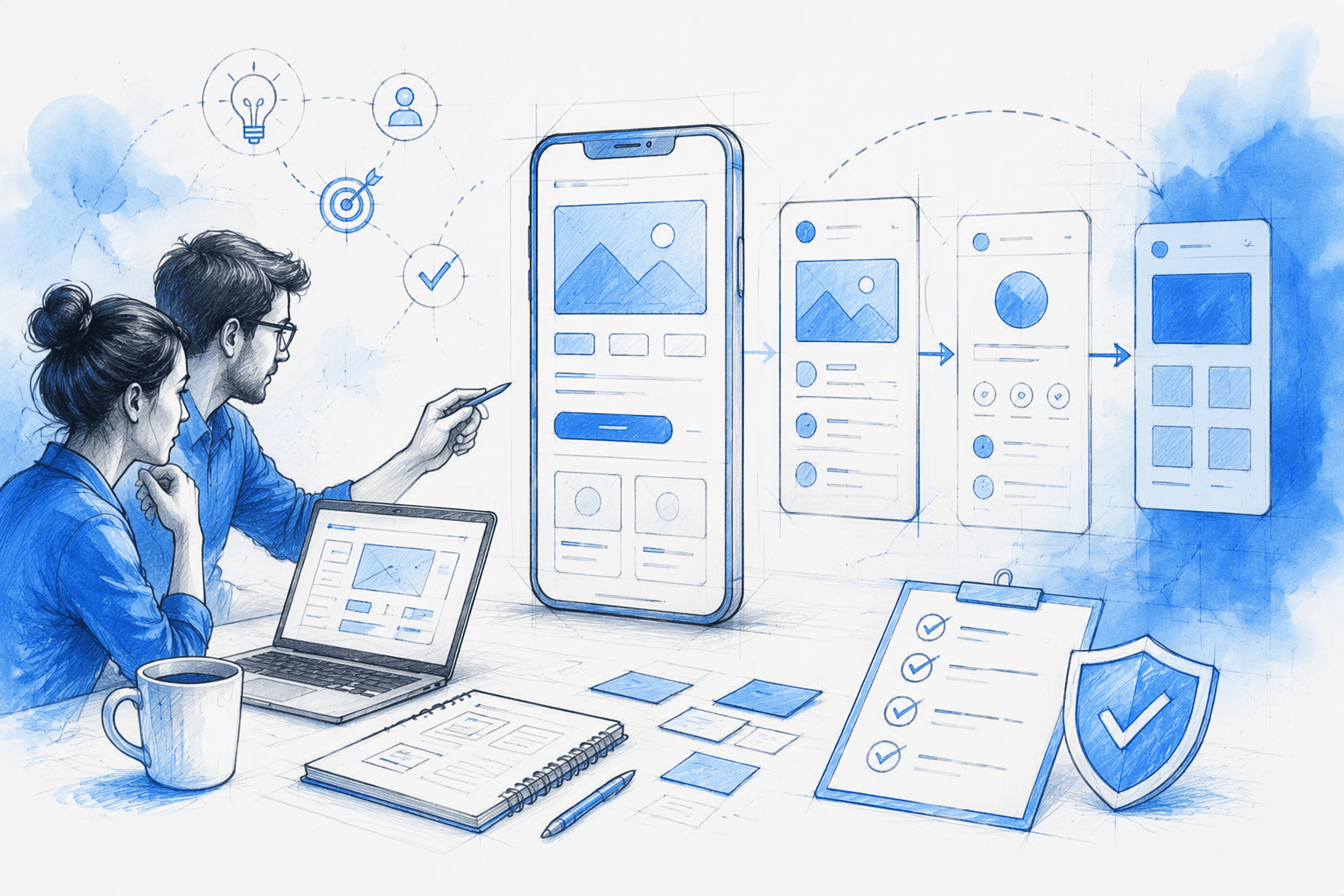
A UI/UX design service should deliver more than polished screens. It should create a clear user journey, support decisions with evidence, account for realistic interface states, and give developers specifications they can implement without guesswork. We assess design work by whether it helps people complete important tasks and whether the intended experience survives implementation.
Table of Contents
- What should a UI/UX design service actually deliver?
- The UI/UX deliverables checklist: what should be included?
- How do you evaluate a UI UX design service beyond the portfolio?
- Independent hybrid designer or UI/UX agency?
- How much does a UX UI designer cost in Bangalore?
- Why frontend knowledge changes UI/UX design quality
- Can AI or ChatGPT create UI design?
- What product-quality UI/UX looks like in practice
- Use this brief before choosing a UI/UX design service
- FAQ
- Turn the difficult flow into a build-ready product
What should a UI/UX design service actually deliver?
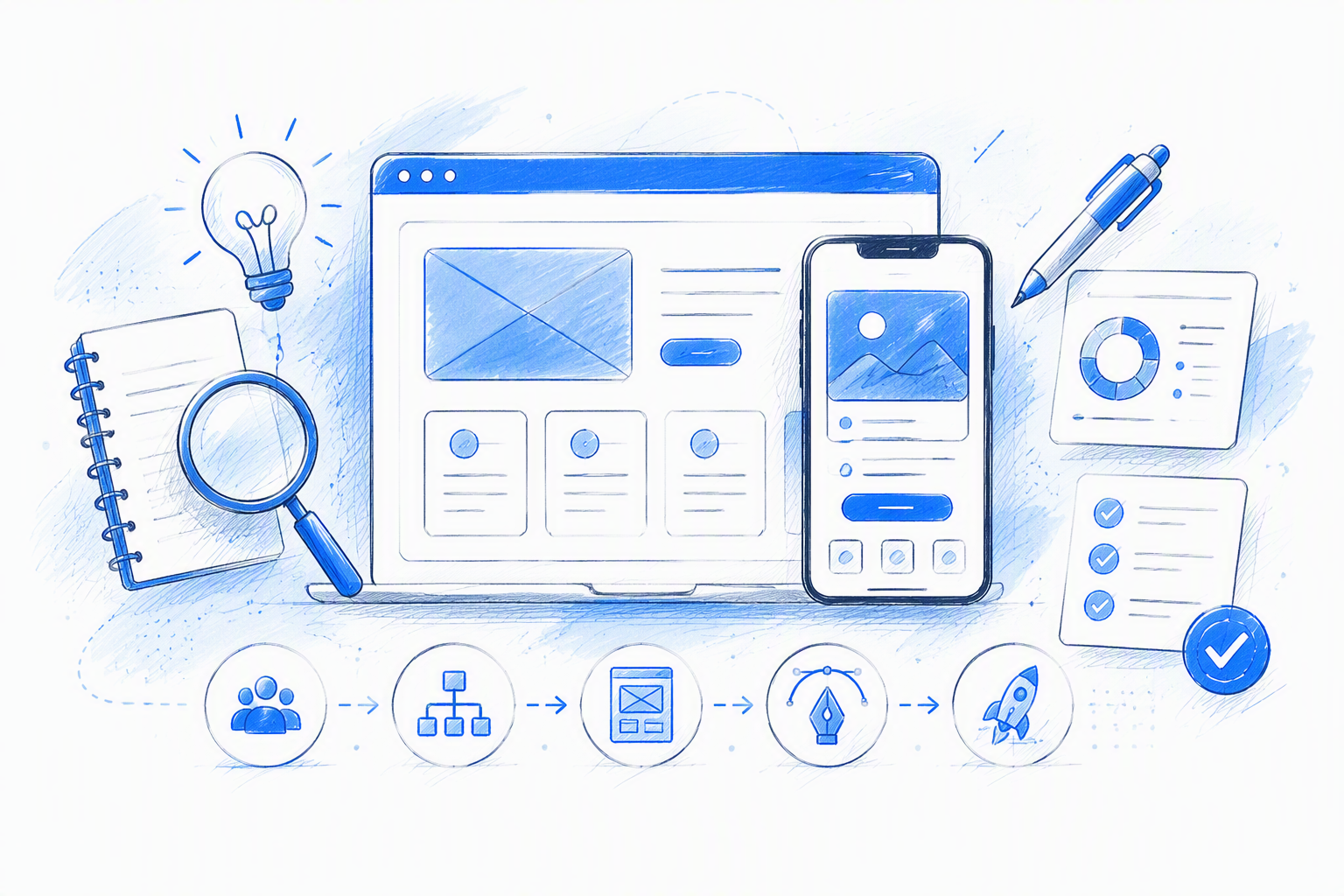
A UI/UX design service should deliver a clearer product journey, defensible decisions, complete interface behaviour, and implementation-ready designs—not just attractive screen files.
We evaluate the work against four practical questions:
- Can users complete the critical task?
- Can the team explain why important decisions were made?
- Are realistic states and responsive conditions covered?
- Can developers build the experience without filling major gaps?
We treat an interface as a working product system rather than a static presentation. Our guide to UI/UX designing services that don’t stop at pretty screens examines this distinction in more detail.
A screen file is not the final product
An attractive mockup can still conceal broken navigation, inaccessible controls, missing feedback, and layouts that fail with real content. Product-quality work accounts for validated flows, interaction rules, responsive behaviour, accessibility, and usable specifications.
UI and UX should not become disconnected handoffs. Hierarchy, focus, validation, feedback, and component states are UX decisions expressed through the interface.
The four outcomes buyers should expect
We recommend evaluating a service through four outcomes:
- Clarity for users: People understand where they are, what to do, and what happened.
- Evidence for stakeholders: Decisions connect to user needs, constraints, tests, or product signals.
- Realistic behaviour for developers: Relevant states and rules are explicit.
- Continuity: Product intent survives research, interface design, and implementation.
These are more useful acceptance criteria than unsupported promises such as “beautiful,” “seamless,” or “user-friendly.”
The UI/UX deliverables checklist: what should be included?
A useful UI/UX checklist connects every artifact to a decision. Depending on the product’s maturity and risk, an engagement may include:
- Discovery findings and prioritised risks
- User flows and information architecture
- Wireframes for testing sequence and hierarchy
- Interface designs with visual and interaction rules
- Prototypes for evaluating uncertain behaviour
- Usability findings and resulting changes
- Accessibility requirements
- Responsive layouts and interface states
- Reusable components
- Handoff notes, assets, and implementation support
Not every project needs extensive research or a large design system. Our end-to-end UI UX design service workflow scales the process around the decisions carrying the most risk.
Discovery outputs that reduce uncertainty
Discovery should leave the team with a defined problem, relevant user needs, known constraints, assumptions, success signals, and prioritised risks. A persona or research report has little value unless it changes a product decision.
We prefer focused evidence over research theatre. An audit, relevant user conversations, and an early prototype may resolve a risky assumption more effectively than broad discovery without a clear purpose.
Flow and interface outputs that cover real use
The designs should cover primary journeys alongside relevant empty, loading, error, success, disabled, permission, and responsive states. Content limits, validation, navigation, system feedback, and accessibility behaviour also need attention.
“Checkout redesign” is too vague. A stronger scope identifies the main purchase flow, failed payments, invalid inputs, loading behaviour, confirmation, mobile layouts, and other conditions that affect completion.
Handoff outputs developers can act on
Developers should receive organised files, reusable components, assets, state definitions, responsive rules, and interaction notes. They also need access to the designer when an unforeseen technical condition appears.
Fewer implementation guesses are a meaningful quality signal. Our checklist for UI UX web design services and build-ready products explains what we inspect before accepting delivery.
How do you evaluate a UI UX design service beyond the portfolio?

A beautiful portfolio is a weak hiring signal on its own. Visual polish can hide unclear reasoning, missing edge cases, shallow testing, and concepts that were never prepared for implementation.
We suggest assessing candidates on:
- Product framing and prioritisation
- Quality of evidence
- Interaction depth
- Accessibility awareness
- Technical realism
- Communication and constructive challenge
- Experience with comparable complexity
The right service depends on product risk, pace, internal capacity, platform constraints, and the environment in which the work will be built.
Ask to see the messy middle
Ask about the ambiguous starting point, constraints, rejected directions, trade-offs, usability findings, and changes made after feedback. Strong case studies connect evidence and product problems to specific interface decisions.
A portfolio should reveal judgment, not only taste. That distinction is central to finding a product designer who can deliver buildable work.
Inspect interaction depth, not screen count
Find out what happens during an error, slow response, first use, repeat use, long-content scenario, small viewport, or keyboard interaction. One deeply resolved transactional flow can reveal more product thinking than a collection of ideal-state screens.
Look for constraints, state rules, component behaviour, and sensible compromises. These details separate decorative concepts from usable product design.
Questions to ask before hiring
Before hiring, ask:
- Who owns research, synthesis, and prioritisation?
- Which assumptions and flows will be tested?
- Which responsive conditions and edge states are included?
- How will files be prepared for development?
- How are scope changes and feedback handled?
- Who answers questions after handoff?
- How will outcomes be observed?
For regional hiring context, our guide to UX designers in India covers practical evaluation criteria.
Independent hybrid designer or UI/UX agency?
Neither model is automatically better. The choice depends on whether the work needs close continuity, broad specialist input, or substantial parallel capacity.
For a focused product, direct access to a hybrid UX, UI, and frontend designer can reduce context loss. Agencies may suit simultaneous markets, platforms, research programmes, or large delivery teams, although a larger team can introduce more handoffs.
When direct collaboration creates an advantage
One accountable design partner can retain context from the initial brief through exploration, testing, visual design, and developer clarification. Frontend awareness also allows feasibility to shape decisions early.
This model often suits founders and lean product teams that need direct collaboration. Our comparison of a hybrid designer, agency, and in-house team can help teams choose an appropriate structure.
When project complexity requires broader capacity
A broader team may be appropriate for:
- Several concurrent workstreams
- Multi-region research
- Specialist regulatory requirements
- Delivery across multiple platforms
- Significant service design and organisational coordination
We recommend choosing according to required capacity and continuity—not agency size or portfolio aesthetics alone.
How much does a UX UI designer cost in Bangalore?
There is no responsible universal price for a UI/UX designer in Bangalore without a defined scope. Pricing commonly uses a fixed project fee, day rate, or retainer, with each model handling uncertainty differently.
A cheap screen-production quote may lead to extra redesign, developer questions, and implementation work. Compare complete outcomes rather than screen totals.
Fixed scope, day rate, or retainer?
- Fixed scope: Suitable for a defined outcome with clear boundaries and a change process.
- Day rate: Useful for audits, workshops, flexible collaboration, or evolving priorities.
- Retainer: Appropriate for continuous product work, iteration, and implementation support.
Before comparing quotes, define testing, responsive coverage, revision limits, handoff, and post-delivery support. Our overview of freelance product design workflows provides more context.
What changes the price?
Cost varies with product complexity, roles, flows, research access, content readiness, platforms, prototype fidelity, accessibility requirements, design-system maturity, and implementation involvement.
A landing-page refresh differs sharply from a transactional product involving permissions, dependencies, validation, and multiple user states. Similar screen counts do not imply similar effort.
Why frontend knowledge changes UI/UX design quality
Frontend understanding informs feasible layouts, component boundaries, state logic, breakpoints, performance-sensitive choices, and resilience to real content. In our work, it helps us spot implementation problems while the interface is still being designed.
Design knowledge does not replace engineering. It supports better collaboration and fewer surprises between approved UI and shipped behaviour, as our guide to UI/UX design services that survive frontend execution explains.
Decisions that static mockups often hide
Static screens can hide overflow, variable content, focus states, touch targets, permissions, validation, latency, loading behaviour, and breakpoint transitions.
A responsive product card, for example, may need to handle different image ratios, long titles, changing metadata, unavailable states, keyboard focus, and reusable implementation logic.
A design system should follow validated product logic
Building a large component library before validating the core journey can formalise weak decisions. We recommend starting with reusable patterns required by tested flows.
The system can expand as genuine consistency needs emerge. This keeps component work tied to real product behaviour.
Can AI or ChatGPT create UI design?
AI and ChatGPT can contribute to UI design, but generation speed is not product judgment. These tools can suggest directions, summarise research, draft interface copy, and speed up repetitive exploration.
They cannot independently guarantee accessibility, usability, originality, technical feasibility, or suitability for a product’s users.
What AI can accelerate
AI can support:
- Early concepts and layout alternatives
- Content and error-message drafts
- Research synthesis
- Documentation
- Routine interface variations
- Visual exploration
We still review the output carefully. Generated patterns can be generic, inconsistent, inaccessible, or detached from the product environment.
What still requires product judgment
People must choose the right problem, reconcile competing needs, understand users, decide what not to build, test assumptions, and adapt designs to technical constraints.
Clients are paying for stronger decisions and accountable execution. AI should make thoughtful work faster, not make unverified output appear finished.
What product-quality UI/UX looks like in practice
Product-quality work connects visual decisions to user tasks. In a grocery experience, for example, the team might improve category discovery, product comparison, scanning, and navigation rather than stopping at a visual refresh.
The interface should explain how categories guide attention, how information is prioritised, and how each pattern supports the next action.
From visual cleanup to clearer grocery discovery
Clear categories help shoppers decide where to look. Strong hierarchy separates navigation, category cues, product information, and actions.
Card density, image treatment, labels, pricing, and spacing then support scanning. These choices matter because they help people complete a task—not simply because the interface looks newer.
Evidence worth requesting from any case study
Ask for usability findings, behavioural data, implementation outcomes, support trends, or clearly labelled qualitative observations. Before-and-after images without context do not demonstrate sound product thinking.
We also recommend asking what changed after testing and which limitations remained. Honest case studies distinguish observed results from assumptions.
Use this brief before choosing a UI/UX design service
A useful brief should identify:
- Product problem
- Target users
- Critical journey
- Existing evidence
- Technical and commercial constraints
- Platforms and environment
- Deadline
- Decision-makers
- Success signals
For more engagement context, review our UI/UX designing services overview.
A one-minute scope checklist
Define what users must accomplish, what currently fails, what evidence exists, and which constraints cannot move. Then confirm the required flows, platforms, roles, states, tests, and handoff outputs.
Clarify ownership, responsive behaviour, accessibility expectations, communication, implementation files, and support after delivery. Unresolved ambiguity often returns as scope tension or developer guesswork.
The final hiring decision
Choose a partner who can explain the problem, expose trade-offs, test risky assumptions, and retain context through implementation. Polish should be expected, not treated as the sole differentiator.
We prioritise reasoning, continuity, interaction depth, accessibility, and implementation realism over screen count or presentation style.
FAQ
What are UI/UX design services?
UI/UX design services structure user journeys, design interfaces, test assumptions, and prepare specifications for implementation. Depending on the product, they may include research, flows, wireframes, prototypes, usability testing, accessibility requirements, responsive states, reusable components, and developer support.
How much does a UX UI designer cost?
Cost depends on complexity, flows, user roles, platforms, research, testing, accessibility, and implementation involvement. Designers may charge a fixed project fee, day rate, or retainer. We recommend comparing included outcomes instead of choosing by screen count alone.
Is UI/UX being replaced by AI?
No, although AI is accelerating parts of screen production and documentation. Product designers remain responsible for framing problems, understanding users, validating decisions, addressing accessibility, and managing technical trade-offs.
Can ChatGPT create UI design?
ChatGPT can suggest interface concepts, user flows, content, requirements, and documentation. An accountable designer still needs to evaluate whether the result fits users, covers edge cases, meets accessibility needs, and works within technical constraints.
Turn the difficult flow into a build-ready product
Bring us your vague brief, difficult flow, or generic interface. We’ll turn it into a distinctive, testable, implementation-aware product experience through our UI UX design service connects product problems to shipped experiences.